










Ashley Hall News & Blog
More Than One Way to Solve: How Ashley Hall Supports Confident Mathemeticians
November 12, 2026
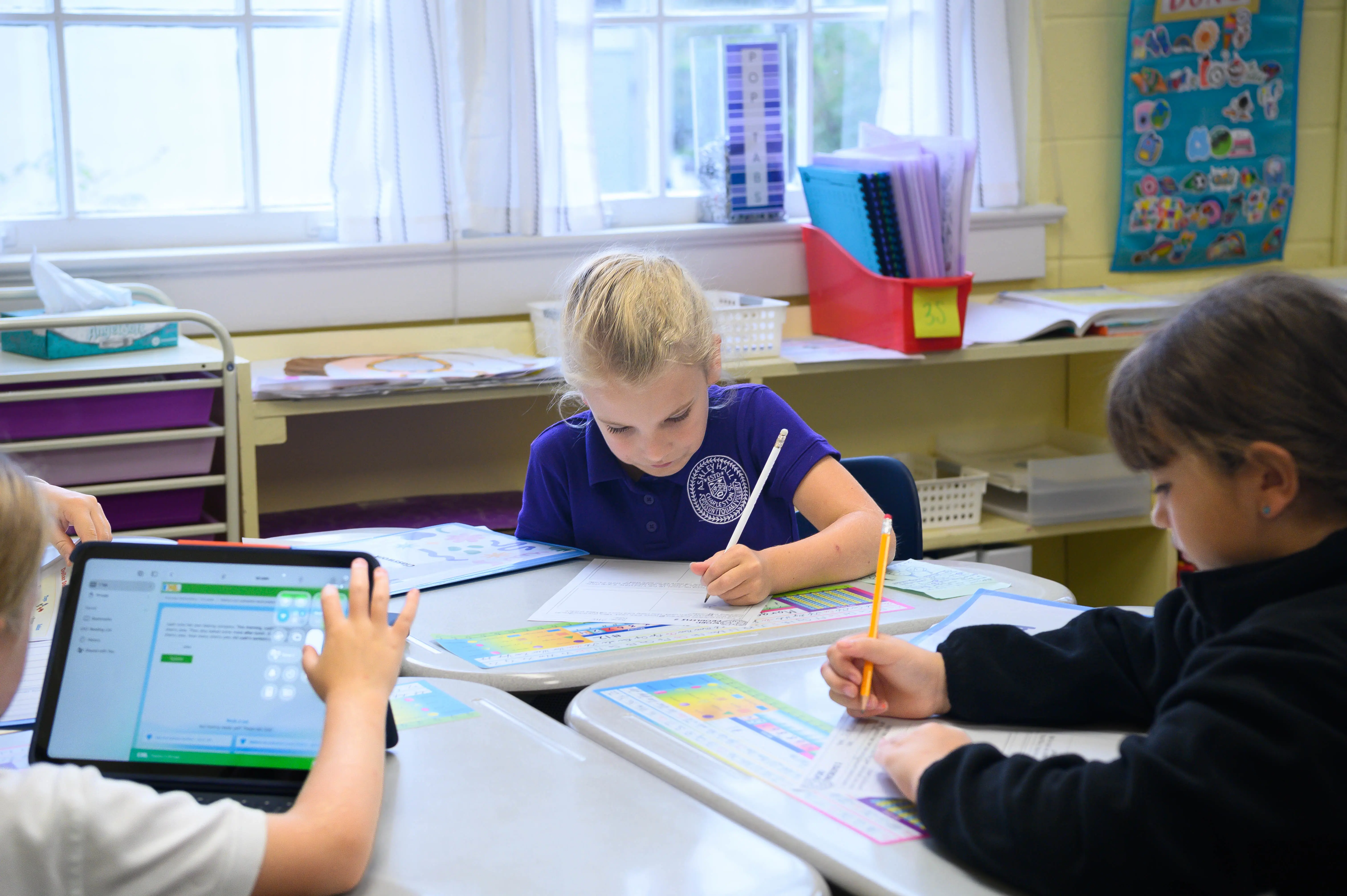
If you’ve ever looked at your daughter’s math homework and thought, "That’s not how I learned to solve this," you’re not alone. Today’s math classrooms have moved far beyond rote memorization, inviting students to explore multiple pathways to an answer and connect numbers to the world around them. At Ashley Hall, this shift empowers girls to become curious thinkers who aren't afraid to tackle complex challenges. Below, Allie Jordan, Lower School Math Specialist and Learning Support Department Chair, walks us through a day in the life of our Lower School mathematicians and explains how our curriculum and digital tools work together to bring math to life.
What is Everyday Math?
Everyday Mathematics is a math curriculum that focuses on teaching students to understand how to solve a problem and why a strategy works. Instead of memorizing facts and following steps to solve a problem, students explore the concepts by making real-world connections and develop a deeper understanding by justifying their answers using appropriate vocabulary. Students are encouraged to test multiple strategies and approaches to solving problems. This allows students to discover that there is more than one way to solve a problem.
What does a day in the life of an Ashley Hall Lower School mathematician look like?
Daily math lessons include different activities that allow differentiation and an individualized approach. Lessons begin with warm-ups and routines to get students thinking about numbers, including mental math, counting, and quick reviews to strengthen problem-solving.
New concepts are introduced in a whole-group setting with teacher-led discussions, modeling, and hands-on activities. The class works through a variety of problems together, using different strategies and asking questions to challenge the thinking process.
After instruction, students have time to collaborate with classmates within small groups, play math games, and explore math manipulatives, allowing them to learn from each other and build confidence.
Students work independently in their math journals to show and apply what they have learned. This gives teachers an opportunity to see where students might need extra support or further challenge.
The Why.
There are many unique aspects to Everyday Mathematics. Learning multiple strategies is one of those that is not the traditional way of learning. Although they are exposed to traditional methods, students are encouraged to use tools and models such as number lines, place-value blocks, fraction pieces, etc. Games are a big part of the Everyday Mathematics curriculum. Games allow students to practice skills, strengthen fact fluency, and develop strategic thinking while practicing collaboration, communication, and perseverance. Everyday Mathematics uses a cyclical approach. Students are introduced to a topic and revisit it throughout the year to build on past and current knowledge. This helps strengthen understanding and supports long-term learning.
IXL and Rocket Math
In addition to our Everyday Mathematics curriculum, we use other resources to support students. IXL is a digital math program that provides opportunities for students to reinforce what is being taught in class as well as target areas of weakness and strength in order to support individualized growth.
Rocket Math is a program used to build math fluency through recalling basic addition, subtraction, multiplication, and division math facts accurately. This allows students to build confidence and free up their thinking in order to focus on more complex problems.
These resources complement our Everyday Mathematics curriculum for additional practice and skill development.
Math in the Real World
There are plenty of opportunities to support your daughter’s learning outside of the classroom. Count objects, look for patterns, talk about time at the start of your day, measure ingredients while cooking, play games; they will eventually even be able to calculate the tip at a restaurant. Encourage your daughter to see math in the real world and ask them questions like “How did you know?” or “Is there another way to show your thinking?”
We want every student to develop a strong foundation in math, feel confident tackling challenges, and understand the why as they discover math all around them.