


Ashley Hall Life
Where Curiosity Begins: A Spider Sparks a Learning Adventure in the Early SchoolJanuary 12, 2026
Curiosity often begins with a single, shared moment—and in the Early School, those moments can grow into meaningful learning adventures. In this blog post, Early School Faculty Member Laura Kernen, reflects on how one child’s discovery sparked a months-long, interdisciplinary exploration rooted in observation, creativity, and scientific thinking for her Primary class. Through her lens, we see how young learners investigate the world around them with wonder, collaboration, and joy.
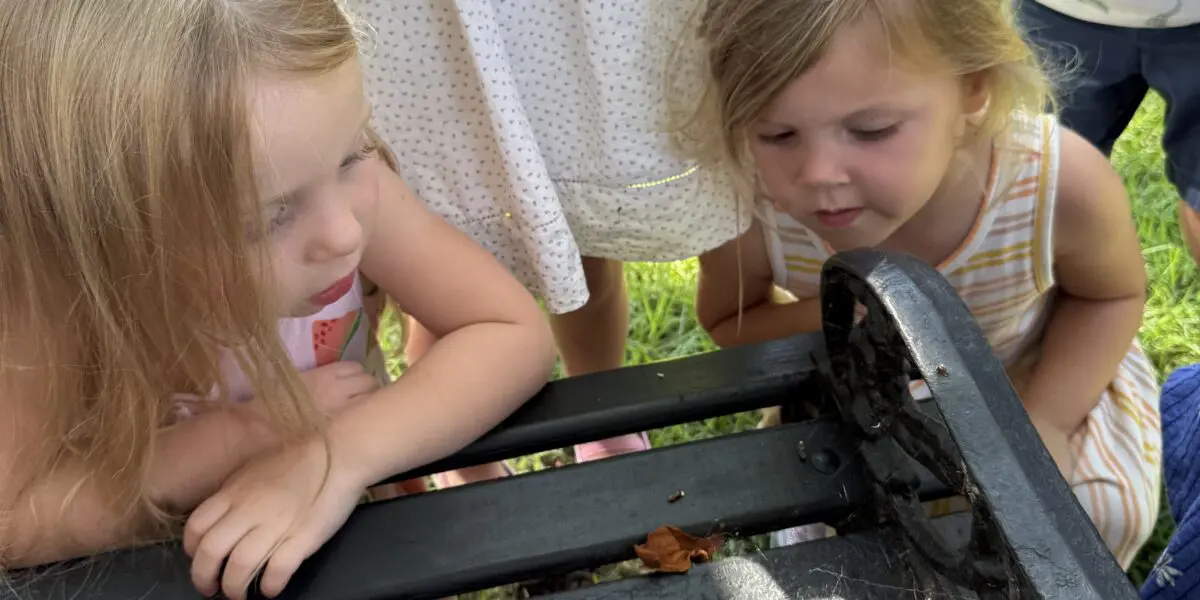
For children in the Early School, the world is a giant laboratory! One day in late August, the children in my and Mrs. Gough’s Primary class were leaving the building and gathering in the Tree House*. As we were waiting for everyone, one of the children exclaimed, “There’s a spider! I see a web!” Excitedly, the others crowded around to see. For the next few days, each time we gathered in the tree house, the children were intensely focused on finding the web and the spider, and on wondering what life was like for the spider. These young scientists then embarked on a deep investigation into spiders. Weaving a web of natural exploration, artistic representation, fictional stories, informational texts, music and movement, and personal theories, both children and adults searched for understanding and knowledge of spiders.
Our investigation began with a morning meeting in which the children took turns sharing their prior knowledge of spiders with the class. Birdie P. shared, “They climb up webs in the rain, and they crawl everywhere.” Finn K. agreed, adding, “They climb up the water spout.” Connecting the song Itsy Bitsy Spider and her experiences outside of school to our conversation, Mila K. said, “They climb up the water spout and slide down (like me!).” After everyone had shared their thoughts, we decided to plan a nature walk around campus, during which children looked for webs and recorded their findings and impressions in their nature journals.
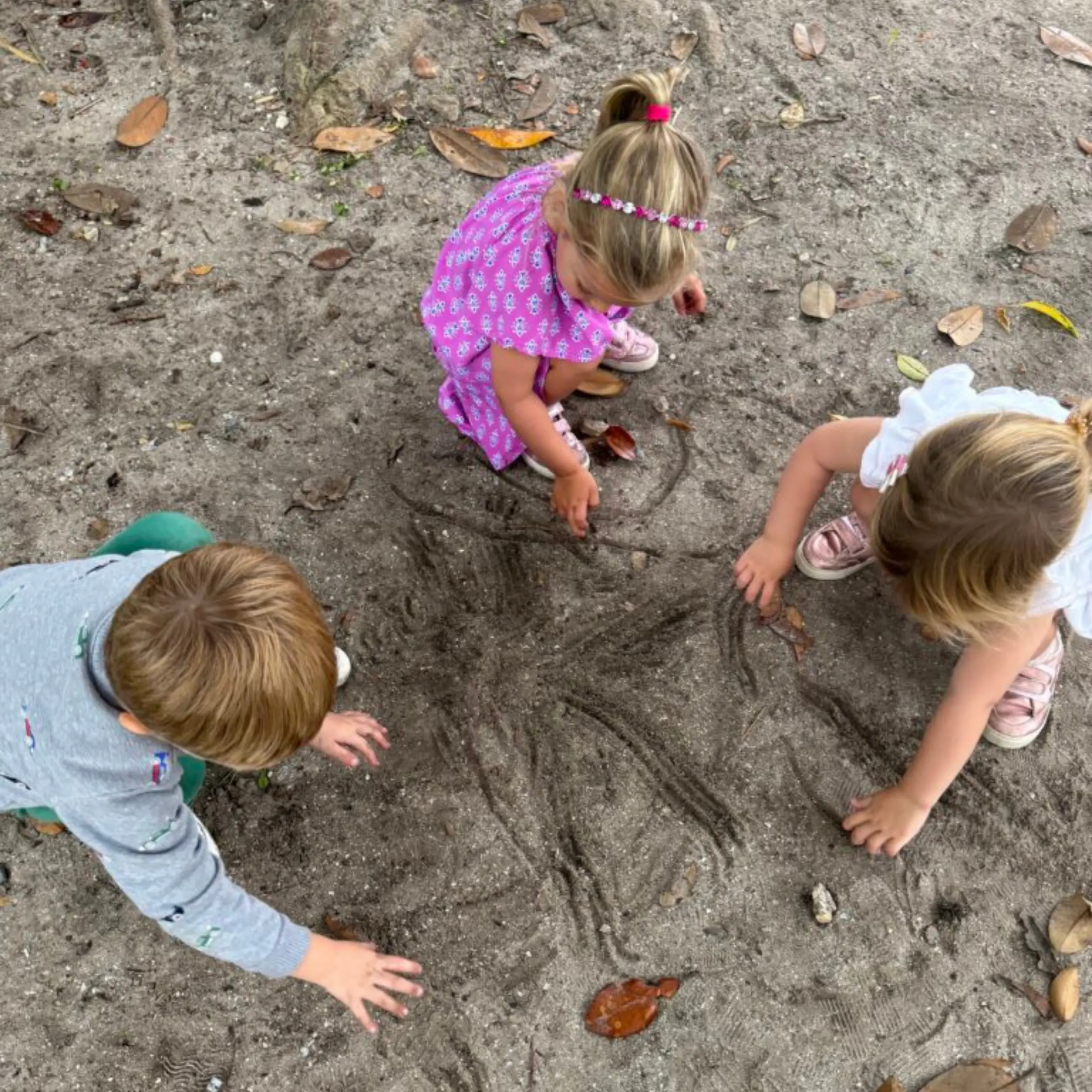
Above: Students explore the shapes of webs, working together to make quick sketches in the sandy ground on campus.
Over the following months, we were guided in our scientific exploration by STEM Cross Cutting Concepts, which are a set of overarching big ideas that look and behave similarly across all STEM domain areas. Here is some more information on each of them, and a bit more background on how we incorporated them into our learning adventure about spiders.
Patterns, Structure, and Function
Patterns: The children identified repeating shapes and noticed how spiders use geometric lines and curves to build their homes.
Structure & Function: The children explored why webs are built the way they are. Using wire and clay, they modeled the web’s physical structure, building it as if they were a spider. Presenting her web to her classmates and teacher, Harper T. said, “I made a web for a home.” Evie B. built her web focusing on its function as a home as well, explaining, “I make a nana spider web. The nana spider helps babies. Helps them stay safe.”
Cause and Effect, Change and Stability
Hands-on creation allowed the children to see how their actions changed the materials.
Cause and Effect: Using tape to create a large “sticky” web demonstrated a direct cause-and-effect relationship—the material’s property (stickiness) is what allows it to trap objects, just like a real web. The children continued working with the sticky web, using loose parts to see what would get trapped in it! Imitating a spider eating the items that got stuck in the web, Ruthie K. exclaimed, “I’m a spider, and I eat all my food!”
Change and Stability: By threading beads onto a decorative spider’s web, the children explored how a delicate structure can remain stable even when we add weight or “decorations” to it. When Zhuri T. finished her bead web, she showed it to her friends, pointing out its length and all the work she had done. Harper answered, “It is so long! You did a lot of work. Good job!”
Systems and Their Interactions & Compare and Contrast
Systems and Their Interactions: We discussed the web as part of a larger system—a tool the spider uses to interact with its environment to survive.
Compare and Contrast: Throughout the investigation, the children compared different mediums. They noticed that a web made of glue differs from one made of wire or beaded string, mirroring how different spiders build unique types of webs (orb vs. funnel).
Literacy and Language
Language and literacy skills were woven into every observation and creation, allowing children to build vocabulary and narrative skills.
Non-fiction and Informational Texts: Reading non-fiction books and watching a video of a spider building a web introduced precise vocabulary (e.g., “spinnerets”) and modeled the language used to describe natural phenomena.
Fiction and Creative Storytelling: We nurtured imagination and critical thinking by reading a fiction story about Walter, who experimented with different web shapes so that his web wouldn’t be blown down by the wind. This sparked discussions about problem-solving and stability in a narrative context.
Using the familiar melody from “Head, Shoulders, Knees, and Toes,” I created a song for the children to sing. They love to sing this song, especially calling out “8 legs” and wiggling their bodies when singing “spinnaret”.
This multi-sensory approach ensures that our youngest learners are building a sophisticated scientific and literary identity through observation, engineering, and storytelling. What started as a simple observation by one child in our class turned into a detailed and engaging investigation across several subjects for all our friends. We are so thankful to spend time with such curious, open-minded, kind minds each and every day.
*The Tree House is a term we use for a meeting place, located just outside the doors to the Early School. It’s a small platform to the side of the ramp, and gives the children a “tree house” view of the Outdoor Classroom. The children use it as a landmark, and all understand what’s expected of them when we gather there in our transitions in and out of the building.