Ashley Hall’s Middle and Upper School students spent a recent morning exploring big questions, bold ideas, and exciting career paths during this year’s STEM Day. It was a dynamic celebration of science, technology, engineering, and math that highlighted not just what our students can do, but who they can become.
The day began with a full-panel session featuring an impressive group of leaders from fields spanning pediatric neurology, aerospace engineering, AI, environmental science, cybersecurity, water quality, design, and engineering leadership. Student moderators guided the conversation with thoughtful, probing questions that brought out personal stories, unexpected career paths, and practical advice.
Dr. Lela Lewis, Division Chief of Pediatric Neurology at the Medical University of South Carolina shared a vivid childhood memory of her mother (also a physician) bringing home a sheep’s brain after teaching a hospital class; a moment that sparked her lifelong fascination with the human brain. “Seeing a child’s development over time and how the brain changes over time has always been fascinating to me,” Dr. Lewis shared. That early curiosity led her through medical school, Air Force service, and advanced training at Johns Hopkins, and ultimately to her leadership role at MUSC. Her story was a powerful reminder that big careers often begin with small moments of wonder.
Students also heard from Rebecca Gleason, Head of Global Industry Engagement for AI & Business Messaging at Meta, whose path to tech leadership was anything but traditional. A liberal arts major who didn’t grow up dreaming of a career in AI, Ms. Gleason emphasized that success in STEM isn’t limited to one specific degree or background. “No matter what degree you choose to pursue, the most important thing you can do is be able to communicate with people in a language they can hear,” she said. A message that resonated deeply with students who are considering how their own interests might intersect with STEM fields.
The panel showcased a remarkable range of expertise. Dr. Lynn Sargent, a structural analysis engineer at Boeing, spoke about research and innovation in aerospace and AI-driven digital transformation. Cole Rise, Director of Design for Microsoft AI and designer of the original Instagram icon, shared how creativity and technology intersect in powerful ways.
From The Citadel, Dr. Deepti Joshi, Dr. Shadi Sadeghpour, Dr. Farhath Zareen, and Dr. Nahid Vesali highlighted cutting-edge work in artificial intelligence, cybersecurity, bioinformatics, engineering leadership, and machine learning, and emphasized the importance of undergraduate research and mentorship.
Environmental leaders also took the stage. Allison Montgomery, Conservation Planner at Westervelt Ecological Services, described using data-driven analysis to protect wetlands and natural resources. Olivia Flynn, Environmental Engineer and Associate Vice President at Hazen and Sawyer, and Guinn Wallover of Mount Pleasant Waterworks, demonstrated how engineering and environmental science directly impact community health and sustainability.
Rounding out the healthcare perspective, Lauren Fogelgren, Head of Health Services at Ashley Hall and a practicing physician assistant, connected clinical care with evidence-based practice and compassion, reminding students that STEM careers are ultimately about improving lives.
After the morning panel, students broke into grade-level groups for smaller, more interactive sessions. These in-depth conversations and hands-on activities allowed students to dive deeper into topics like AI ethics, water treatment systems, cybersecurity threats, neurological research, and engineering project management. The smaller setting created space for candid questions, mentorship, and meaningful dialogue about internships, college majors, and work-life balance.
Throughout the day, one theme rose above the rest: there is no single path into STEM. Whether sparked by a childhood memory, a love of the outdoors, a passion for problem-solving, or an interest in storytelling and design, each panelist demonstrated that curiosity, resilience, and communication are just as important as technical skill.
STEM Day at Ashley Hall did a wonderful job of highlighting the different career options available to students, but it was also about possibility. It was a celebration of leaders in complex, innovative fields and an invitation for our students to imagine themselves doing the same.
Technology is everywhere; new tools and AI features are appearing daily. Some celebrate these innovations as ways to expand access to skills like coding and design. Others raise important questions about well-being and the impact of screens on young children.
In the Early School, we begin with a different question: How can technology become a language for thinking? When used thoughtfully and intentionally with our youngest learners, technology is not entertainment. It is not a pacifier. It is not a replacement for blocks, clay, paper, light, or books. Instead, it lives alongside these materials as another expressive language; one that allows children to research, design, document, test theories, and share their thinking.
Tools for Inquiry, Not Distraction
When many people hear “technology,” they immediately think of screens. In our classrooms, however, technology includes microscopes, projectors, light tables, 3D printers, and cameras. These tools are present in ways that invite exploration and provoke questions.
It is a joy to watch children experiment with shapes on the light table, noticing symmetry, transparency, and pattern. In the fall, I observed projectors casting images connected to classroom investigations. In one room with students who were studying trees, projected images extended the children’s thinking. Together, we discussed how iPads could be used as tools for photography. The class took a “field trip” to Senior Lawn to explore point of view—crouching low, stretching tall, capturing bark texture, branches against the sky, and shifting light.
The iPad became a research tool. A storytelling tool. A way to revisit and reflect. The lesson was simple but powerful: technology is something we use with purpose. It is active, not passive.
Making, Building, Coding
In another classroom, children were exploring building and visited our growing maker space in the library to see 3D printers in action. Watching a design move from digital concept to physical object sparked questions about structure, stability, and process. The printer was not the focus, the thinking was.
Early coding is happening, too. When children work with some of these tools, they are not “just pressing buttons.” They are predicting outcomes, sequencing steps, revising plans, and persisting through challenges. Coding becomes an exercise in logic, collaboration, and problem-solving.
The same is true when children enter the Star Lab or use digital tools to document their discoveries. They are testing hypotheses. Communicating ideas. Engaging in design thinking.
Modeling Thoughtful Use
Our children are always watching us. They see adults using phones to send messages, search for information, FaceTime family, or ask digital assistants questions. Technology is already embedded in their world. Our responsibility is to model intentional, balanced use.
Teachers may choose to use iPads for documentation or music with intention. Children see the use of devices with clear purpose, to photograph an investigation, record observations, or share their learning with others.
The Library as a Hub of Innovation
Our library continues to evolve as a vibrant hub where books, materials, and digital tools intersect. The maker space, Star Lab, and research tools live alongside stories, natural materials, and studio spaces.
Children move fluidly between media: sketching a design, building with blocks, investigating for research, and projecting images to spark discussion. The boundaries between “digital” and “hands-on” dissolve. All of it is learning. All of it is language. In a world filled with screens, our goal is not to shield children from technology nor to immerse them in it. Instead, we guide them in using it thoughtfully.
When technology is treated as a language for thinking, it becomes what it was always meant to be: a medium for invention, imagination, and connection.
Susannah Elliott
Technology Integration Specialist
In a Reggio Emilia–inspired classroom, children are understood to have many languages for expressing their thinking and emotions—movement being one of the most powerful. Young children communicate, regulate, and make meaning through their bodies long before they can fully articulate their feelings with words. When we honor movement as a language, we create space for children to develop self-regulation in ways that feel natural, joyful, and deeply connected to their learning. This inquiry into birds and feathers offers a beautiful example of how physical movement and social-emotional growth are thoughtfully woven into the everyday life of our pre-Kindergarten classrooms.
Elizabeth Johnson ’95, Early School faculty member and pre-Kindergarten teacher, offers a window into this work through her classroom’s recent inquiry into birds and feathers—an exploration that beautifully illustrates how movement, observation, and social-emotional development are woven together in the everyday life of our Early School.
Over the past few weeks, the children in our pre-Kindergarten class have been deeply engaged in studying birds and feathers. They have been watching how birds move, where they rest, how feathers respond to wind and water, and how wings help bodies lift, glide, and pause. Feathers have become a powerful material for observation, inviting children to notice texture, lightness, pattern, and movement. What may appear to be joyful observation and imaginative play is also meaningful work in developing self-regulation.
As children watched birds flutter, perch, and take off, they began to notice that movement is thoughtful rather than random. Birds flap their wings, rest, shake off water, or allow the wind to carry them—each action serving a purpose. Feathers play an important role in this process. Children observed how feathers flicker in the wind, fall slowly to the ground, or shift with a gentle touch.
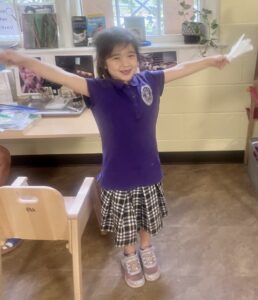
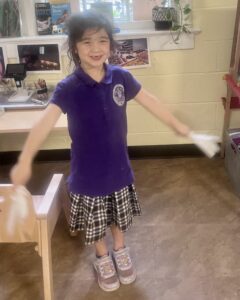
Through these experiences, children explored their own bodies in similar ways. They flapped their arms, wiggled, slowed down, and tiptoed carefully so as not to scare a bird. In these moments, children were practicing listening to their bodies, adjusting their energy, and responding thoughtfully to their environment.
This kind of learning supports self-regulation in powerful and developmentally appropriate ways. Rather than asking children to sit still, we invite them to move with intention, just as birds do. Movement, drawing, storytelling, and working with materials like feathers allow children to practice shifting between excitement and calm, action and rest. Watching a feather float slowly or settle gently on the ground offers children a visual and sensory reminder that slowing down can feel good and purposeful.
As the children flap, spin, and release feathers, their bodies begin to find rhythm and calm. These playful movements help children release energy, settle themselves, and build emotional balance. Through this sensory play, children practice regulating their emotions in ways that feel authentic and embodied.
“If I flap like this, I can fly! Watch me—flap flap!”
Families can support this work at home by noticing birds together, collecting fallen feathers, or observing how the wind moves leaves and other lightweight objects. Gentle questions, such as What do you think the bird needs right now? How does the feather move? or How does your body feel when you move fast or slow? help extend children’s awareness and reflection.
We are excited to continue this inquiry alongside another pre-K classroom and to extend it during our upcoming field trip to Mulberry Pond Park, where children will observe birds, feathers, and habitats firsthand. On February 10, Birds of Prey will visit the Early School for a demonstration lesson. We can’t wait to see how the children’s thinking, curiosity, and self-awareness continue to take flight!
Elizabeth Johnson ’95
Pre-Kindergarten Teacher
Curiosity often begins with a single, shared moment—and in the Early School, those moments can grow into meaningful learning adventures. In this blog post, Early School Faculty Member Laura Kernen, reflects on how one child’s discovery sparked a months-long, interdisciplinary exploration rooted in observation, creativity, and scientific thinking for her Primary class. Through her lens, we see how young learners investigate the world around them with wonder, collaboration, and joy.
For children in the Early School, the world is a giant laboratory! One day in late August, the children in my and Mrs. Gough’s Primary class were leaving the building and gathering in the Tree House*. As we were waiting for everyone, one of the children exclaimed, “There’s a spider! I see a web!” Excitedly, the others crowded around to see. For the next few days, each time we gathered in the tree house, the children were intensely focused on finding the web and the spider, and on wondering what life was like for the spider. These young scientists then embarked on a deep investigation into spiders. Weaving a web of natural exploration, artistic representation, fictional stories, informational texts, music and movement, and personal theories, both children and adults searched for understanding and knowledge of spiders.
Our investigation began with a morning meeting in which the children took turns sharing their prior knowledge of spiders with the class. Birdie P. shared, “They climb up webs in the rain, and they crawl everywhere.” Finn K. agreed, adding, “They climb up the water spout.” Connecting the song Itsy Bitsy Spider and her experiences outside of school to our conversation, Mila K. said, “They climb up the water spout and slide down (like me!).” After everyone had shared their thoughts, we decided to plan a nature walk around campus, during which children looked for webs and recorded their findings and impressions in their nature journals.
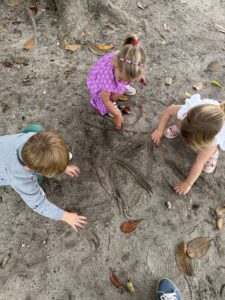
Above: Students explore the shapes of webs, working together to make quick sketches in the sandy ground on campus.
Over the following months, we were guided in our scientific exploration by STEM Cross Cutting Concepts, which are a set of overarching big ideas that look and behave similarly across all STEM domain areas. Here is some more information on each of them, and a bit more background on how we incorporated them into our learning adventure about spiders.
Patterns, Structure, and Function
Patterns: The children identified repeating shapes and noticed how spiders use geometric lines and curves to build their homes.
Structure & Function: The children explored why webs are built the way they are. Using wire and clay, they modeled the web’s physical structure, building it as if they were a spider. Presenting her web to her classmates and teacher, Harper T. said, “I made a web for a home.” Evie B. built her web focusing on its function as a home as well, explaining, “I make a nana spider web. The nana spider helps babies. Helps them stay safe.”
Cause and Effect, Change and Stability
Hands-on creation allowed the children to see how their actions changed the materials.
Cause and Effect: Using tape to create a large “sticky” web demonstrated a direct cause-and-effect relationship—the material’s property (stickiness) is what allows it to trap objects, just like a real web. The children continued working with the sticky web, using loose parts to see what would get trapped in it! Imitating a spider eating the items that got stuck in the web, Ruthie K. exclaimed, “I’m a spider, and I eat all my food!”
Change and Stability: By threading beads onto a decorative spider’s web, the children explored how a delicate structure can remain stable even when we add weight or “decorations” to it. When Zhuri T. finished her bead web, she showed it to her friends, pointing out its length and all the work she had done. Harper answered, “It is so long! You did a lot of work. Good job!”
Systems and Their Interactions & Compare and Contrast
Systems and Their Interactions: We discussed the web as part of a larger system—a tool the spider uses to interact with its environment to survive.
Compare and Contrast: Throughout the investigation, the children compared different mediums. They noticed that a web made of glue differs from one made of wire or beaded string, mirroring how different spiders build unique types of webs (orb vs. funnel).
Literacy and Language
Language and literacy skills were woven into every observation and creation, allowing children to build vocabulary and narrative skills.
Non-fiction and Informational Texts: Reading non-fiction books and watching a video of a spider building a web introduced precise vocabulary (e.g., “spinnerets”) and modeled the language used to describe natural phenomena.
Fiction and Creative Storytelling: We nurtured imagination and critical thinking by reading a fiction story about Walter, who experimented with different web shapes so that his web wouldn’t be blown down by the wind. This sparked discussions about problem-solving and stability in a narrative context.
Using the familiar melody from “Head, Shoulders, Knees, and Toes,” I created a song for the children to sing. They love to sing this song, especially calling out “8 legs” and wiggling their bodies when singing “spinnaret”.
This multi-sensory approach ensures that our youngest learners are building a sophisticated scientific and literary identity through observation, engineering, and storytelling. What started as a simple observation by one child in our class turned into a detailed and engaging investigation across several subjects for all our friends. We are so thankful to spend time with such curious, open-minded, kind minds each and every day.
*The Tree House is a term we use for a meeting place, located just outside the doors to the Early School. It’s a small platform to the side of the ramp, and gives the children a “tree house” view of the Outdoor Classroom. The children use it as a landmark, and all understand what’s expected of them when we gather there in our transitions in and out of the building.
Laura Kernen
Early School Faculty Member
As we approach the end of the calendar year—and look ahead to a well-earned holiday break—it feels especially fitting to pause and reflect on the many moments that have made this semester so special. Across our campus, classrooms, studios, stages, athletic fields, and gathering spaces have been alive with creativity, collaboration, and connection.
This calendar-year-end snapshot offers a glimpse of just some of the powerful learning and community-building happening at Ashley Hall across all divisions. We hope you feel as proud and inspired by these highlights as we do when we witness them each day.
Early School: Inquiry in Action
Our Early School educators continue to shine as leaders in constructivist, child-centered learning. This fall, several teachers participated in national workshops and conferences—and three even presented at the Association for Constructivist Teaching Conference, a remarkable honor for any early childhood program. Faculty are also working closely with Italian pedagogista Tiziana Filippi to deepen their understanding of the Reggio approach, helping refine the ways they document children’s thinking and inquiry. And with fall explorations and festive family events, our youngest learners have welcomed parents into the process, creating meaningful home–school connections.
Lower School: Innovation and Joyful Learning
Lower School faculty have embarked on an exciting journey to strengthen language arts instruction, piloting the Arts and Letters curriculum in third grade. Seeing students so deeply engaged—one even declaring, “You know what I love? I love this school!”—has affirmed the team’s dedication to thoughtful curriculum design. Grade-level teams are now preparing to bring the curriculum to all Lower School classrooms next year, supported by ongoing professional learning. Another standout moment this semester: VIP Days, where students shared culminating project work with special guests. These celebrations showcased authentic learning and highlighted the joy of connection.
Middle School: Community, Service, and Leadership
Middle School students have been building their leadership muscles through community engagement. The seventh- and eighth-grade student councils helped design a meaningful Impact Assembly, inviting students to reflect on how they contribute to their school and local communities. This spirit extended into the holiday season through Branches of Joy, a project in which students crafted miniature Christmas trees for children spending the holidays at MUSC Children’s Hospital. Supported by advisors, the project was a beautiful example of IB service learning in action. A student-led bake sale rounded out the effort, making the hallways buzz with generosity and teamwork.
Upper School: Curiosity, Challenge, and Global Perspectives
Upper School faculty have been hard at work imagining the future of Ashley Hall as the division continues its shift toward becoming an IB school. This fall, teams of educators visited seven peer schools across the country—gathering inspiration, best practices, and bold ideas to bring back to Charleston. Ninth graders also enjoyed the Freshman Flip, a hands-on introduction to life in the Upper School designed by a dedicated group of teachers. Meanwhile, 30 students participated in a dynamic Model United Nations experience, representing countries from across the globe at a 475-person conference. The trip was so impactful that a second MUN experience at Duke University is already in the works for the spring.
Athletics: Record-Setting Momentum
Ashley Hall Athletics is closing out the semester with tremendous energy. Our Sailing Team, now the largest in school history, is posting strong results across the Southeast, while our Equestrian Team continues to collect top-three finishes early in the season. Varsity Basketball, led by first-year coach Bryan Bednar, looks sharp heading into a slate of holiday tournaments, and our Archery Team—now our biggest athletic team—saw 14 of 26 members achieve new personal records at their most recent tournament. With strength and conditioning underway for spring sports, it’s shaping up to be an exciting year across all teams.
Arts: Creativity That Connects
The Performing Arts Department has welcomed families into studios and rehearsal spaces this fall, offering a behind-the-scenes look at the craft and discipline of theater, dance, and strings. Highlights include:
– Parent demonstrations across the arts
– Red Choir and Honors Red Choir performing at Franke at Seaside Retirement Community
– Four orchestra students selected for Region Orchestra, performing with top musicians from across the region
And of course, this season marked the 101st year of the Christmas Play, a beloved Ashley Hall tradition brought to life through the dedication and artistry of our student performers, faculty, and volunteers.
Admission: Welcoming the Next “Purple & White” Generation
The Admission team has already welcomed 90 families for campus tours and hosted 20 student visits, setting a strong tone for the season ahead. From the Freshman Flip to special retention events, their energy is helping new and returning families feel connected and excited about life at Ashley Hall.
Operations & Health Center: Caring for Campus and Community
Behind the scenes, our Operations Team has been hard at work: from completing the McBee House elevator renovation (just in time for the Alumnae Holiday Party!) to making progress on roofing, HVAC upgrades, and stormwater improvements. Our incredible school nurses have also navigated the semester with extraordinary grace, maintaining a warm and steady presence for our community. We look forward to welcoming Lauren Fogelgren as our new Director of Health Services in January.
A Community Rooted in Pride and Purpose
This semester has been filled with growth, achievement, creativity, and connection—and we are deeply grateful to the educators, staff, students, and families who make this community so vibrant. As we approach winter break, we hope you feel as much pride as we do in all we have accomplished together.
Here’s to a restful holiday season and the exciting months ahead!
Ashley Hall students continue to distinguish themselves on the stage and in the studio, earning recognition at the local, state, and even national level for their remarkable musical talents. Whether composing original works, performing in elite ensembles, or receiving prestigious certifications, our students are rising stars in the world of music—and they’re doing it with grace, dedication, and heart.
Music lessons are offered as an extracurricular option at Ashley Hall, and the number of students choosing to pursue private instruction is growing. This year, the results speak volumes—not only in accolades but in the passion and discipline our musicians bring to their craft.
All-State Orchestra Honors
After an incredibly competitive audition process, three middle school students earned their place in the South Carolina Music Educators Association 6–8th Grade All-State Orchestra:
Sky Malloy ’28 (cello)
Ruby Ghatnekar ’29 (violin)
Adya Sharma ’29 (cello)
These talented young musicians spent a weekend in Spartanburg rehearsing with top student musicians from across the state, culminating in a powerful full-orchestra performance under the baton of a renowned conductor. Special thanks to their private lesson teachers—Zoe Walker, Aubrey Goio, and Cameron Williams—for helping them prepare for this honor.
Royal Conservatory of Music Recognition
Congratulations to Pearson James ’34, who earned a Royal Conservatory State Certificate of Excellence in piano—an Ashley Hall first! Pearson’s dedication and artistry were celebrated at a Lower School Assembly this year.
Also deserving applause is Beatrice Watson ’31, who received the highest mark in South Carolina for Level 2 Piano from the Royal Conservatory of Music.
Carnegie Hall Appearance
A special bravo to Adya Sharma ’29, who recently performed at Carnegie Hall with the Charleston Symphony Youth Orchestra (CSYO). Sharma has been an active CSYO member and string quartet performer, joining the orchestra onstage alongside the College of Charleston Orchestra and the Charleston Symphony Orchestra—an ensemble that includes several of Ashley Hall’s own string faculty members: Ben Weiss (viola), Frances Hsieh (violin), and Maggie Gould (violin).
Charleston Achievement Day Accolades
Seventeen Ashley Hall pianists participated in the Charleston Music Teachers Association’s Achievement Day at Charleston Southern University this March. This event challenges young musicians to showcase their skills in performance, technique, sight reading, and music theory. Ellie Murphy ’32 was named an alternate for her level and recognized in the Honors Recital program. Sriya Banik ’30 received the Crescendo Award and a trophy for consistently high scores. Thanks to our outstanding piano faculty—Anna Brock, Dan McCurry, Jan Smith, and Dr. Sooyun Yun—for their mentorship.
Charleston Achievement Day Participants:
Naomi Grek ’33
Sophie Deupree ’35
Charlotte Deupree ’33
Katie Solomon ’34
Ellie Murphy ’32
Sriya Banik ’30
Jaalah Brown ’26
Lucy David ’28
Ella Donohoe ’31
Annie Donohoe ’33
Emilia Goodwin ’32
Elly Middleton ’33
Madeleine Kopf ’29
Rhetta Lowndes ’31
Sidney James ’36
Pearson James ’34
Suzanne Groat ’27
Composition Competition Triumphs
Our students aren’t just performing—they’re creating. This year saw an impressive sweep across composition contests, from local to international stages.
Highlights include:
Charlotte Deupree ’33, whose original work “Night Waves” won 1st place in the NFMC Junior Composers Contest (South Carolina), Winner in the Southeast Regional round, and Winner of the South Carolina Music Teachers Association Composition Competition (Elementary Solo). She also received Honorable Mention in the International Piano Composition Contest.
Naomi Grek ’33 composed “Bunny Rabbit Hare,” which placed 2nd in the Charleston Sonatina Festival, won in the International Piano Composition Contest, and received Honorable Mention in the Piano Inspires Kids Magazine “Movie Score” Contest.
Eleanor Gilliespie ’35 earned Runner-Up in the SCMTAC Composition Competition (Elementary Solo) for “The Cave.”
Camila Zuniga ’28 was named Runner-Up in the Piano Inspires Kids Magazine “Movie Score” Contest (13–15 age group) for her piece “Mysteries.”
We are incredibly proud of these students—and the dedicated faculty who guide them—for representing Ashley Hall with such talent and determination. Their achievements show just how far music can take you when passion meets opportunity.
Ashley Hall is a K-12 independent school for girls, with a co-ed preschool, committed to a talented and diverse student population. We consider for admission students of any race, color, religion, and national or ethnic origin.