As the fall athletics season came to a close, our student-athletes demonstrated exceptional commitment, resilience, and talent. This season was marked by outstanding performances, meaningful milestones, and a strong sense of community across Ashley Hall Athletics. Here’s a look back at the achievements that defined our fall season.
Tennis Secures Consecutive State Championships
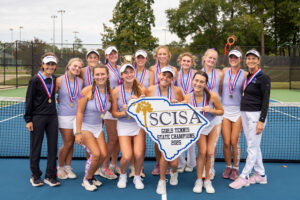 Our varsity Tennis team completed an undefeated season and claimed their second straight State Championship, closing out the year with a decisive victory over Trinity Collegiate. Their dedication and consistency set a remarkable standard for excellence. Special congratulations to Lily Sloan ’26 on being named SCISA Player of the Year!
Equestrian Opens the Season with Strong Results
 The Equestrian team began the season with impressive momentum, earning second place in their first show and first place in the following competition. Their early success signals a promising season ahead. PQV!
Cross Country Demonstrates Competitive Strength
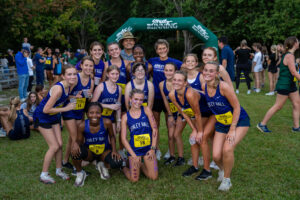
Cross Country earned a second-place finish at the region meet, highlighted by top-seven performances from Molly Mettler ’27 and Natalie Bennett ’27. Reflecting on the team’s progress, Molly shared: “It was such good vibes and I really felt all the team love… We’ve made a really big jump this season in intensity, and we’re all so supported by each other and by the Ashley Hall community.” The team now turns its focus to the State Meet in Columbia.
Swimming Earns State Runner-Up Finish
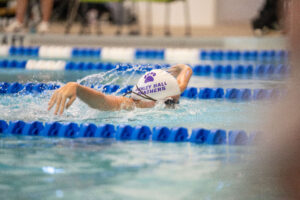 The Swim team delivered an outstanding performance at the state championship meet, finishing as State Runner-Up. Coach Cassidy Rindge reflected on the team’s accomplishments:
“We had four podium finishes and a new school record. The girls took a lot of ownership over their season… They came together as a team which was really cool. It’s such a positive trajectory.”
Celebrating Excellence: Charlotte Strickland ’26 Signs with Tulane University
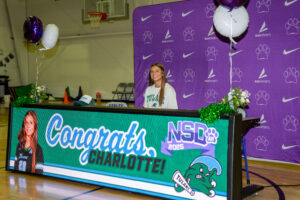 A standout moment of the fall season was the celebration of senior Charlotte Strickland ’26, a leader on our Varsity Volleyball team, as she officially signed her National Letter of Intent to play Division I Volleyball at Tulane University. A special ceremony was held in the gym, where teammates, coaches, family, and friends gathered to recognize her achievement and witness this meaningful milestone. Charlotte’s commitment, both on and off the court, has been an inspiration to our community. We congratulate her on this well-deserved accomplishment and wish her continued success—all our best and PQV!
Thank you for following this month’s Panther Recap. Stay connected with @AshleyHallPanthers for ongoing highlights, announcements, and stories from across our athletic community.
Ashley Hall is thrilled to host Dream Day Charleston on Saturday, January 10, 2026, a fun and inspiring STEM workshop presented by DreamGirls Initiative. Designed to spark curiosity and empower the next generation of thinkers and makers, this free one-day event invites girls in 5th through 8th grade to explore the exciting world of science and engineering.
Event Details:
Date: Saturday, January 10, 2026
Time: 10:00 a.m.–1:30 p.m.
Location: Ashley Hall
Who: Girls in 5th–8th grade
Cost: Free (registration is required)
Registration opens December 1, 2025. Click here to register!
Participants will spend the day engaging in hands-on activities led by women engineers and scientists from a wide range of fields. From creative problem-solving to real-world experiments, students will experience what STEM professionals do every day—while meeting role models who show just how many paths are possible for women in STEM fields.
Event Highlights:
-Interactive STEM workshops led by industry professionals
-Opportunities to connect with inspiring women in engineering and science
-Free giveaways
-A fun, welcoming environment designed to celebrate curiosity
We look forward to welcoming young scientists and engineers to campus for a day of exploration, inspiration, and discovery!
Each December, as the holiday season approaches, the Ashley Hall community embraces a long-standing tradition rooted in generosity. For thirty years, Ashley Hall has partnered with Chicora Elementary School in North Charleston to bring holiday joy to its students through the Chicora Gift-Giving Project—a beloved expression of compassion and connection that continues to grow stronger each year.
What began decades ago as a simple collection of toys has evolved into a thoughtful and deeply personal effort to meet the unique needs of every child at Chicora. Working closely with classroom teachers, Ashley Hall students, and families ensures that each Chicora student in grades 1–5 receives a personalized gift bag filled with essentials and special surprises—from warm coats and shoes to books and toys—all carefully packed and labeled with each child’s name.
These red Santa bags represent far more than festive wrapping and ribbon. For many Chicora students, the sense of consistency, care, and belonging they bring extends well beyond the holidays. Every item donated is a reminder that someone in their wider community is thinking of them.
Behind the project are two remarkable Ashley Hall community members—Elizabeth Blackman ’05, an educator at Chicora Elementary, and Dana Van Hook, former Early Education Director—who continue to lead this meaningful partnership. Together, they coordinate wish lists, organize donations, and ensure every gift reaches a child who needs it most.
Through this annual effort, Ashley Hall students are reminded that generosity is about more than giving—it’s about understanding, empathy, and shared humanity.
At its heart, the Chicora Gift-Giving Project exemplifies the power of girls working together to create positive change, to lead with compassion, and to make a difference in the lives of others. This season and every season, Ashley Hall celebrates the joy that comes from giving, connecting, and uplifting one another.
In the Early School, independence isn’t a milestone to be reached—it’s a rhythm we nurture every day. From zipping jackets after morning arrival to reflecting on the day’s discoveries before dismissal, each moment offers children a chance to practice confidence and self-reliance in joyful, meaningful ways. This month, Pre-Primary teacher Amy Kuenzel reflects on the beauty of these small steps toward independence—both for her students and for herself. In her piece, she invites us into a world where learning is alive with curiosity, courage, and connection, reminding us that growth—no matter our age—is always a hands-on, heart-first journey.
This year marks my first year in Pre-Primary, and let me tell you, it’s been a joyful, messy, shoe-on-the-wrong-foot kind of adventure. Our biggest celebration right now? Independence! We’re cheering as little hands zip jackets, pack rest bags, and wrestle swim bags into submission. I mean, just look at Charlotte’s face when she put on her swim backpack all by herself this month (below)—pure triumph! If you could bottle that look of pride, it would be the most powerful motivator on Earth.

Watching these small victories unfold reminds me that independence doesn’t just happen overnight. It’s practiced and nurtured. The same could be said for us teachers. We, too, are learners, constantly refining our craft, growing in confidence, and sometimes, metaphorically, trying to figure out which strap goes over which shoulder.
Professional development has always been one of my favorite parts of being an educator. Over the years, I’ve been fortunate to visit the Boulder Journey School, study in Reggio Emilia, Italy, and most recently, present at the Association for Constructivist Teaching Conference (ACT). My session, “Moving and Meaning: A Constructivist Take on Acquiring Piaget’s Knowledge Types,” explored the simple yet profound question: What is movement?
Movement is how children make sense of the world. It’s not just wiggling or running or dancing. It’s thinking in motion. Movement is the bridge between doing and understanding, the first language of learning. When a child learns to ride a tricycle, carries a backpack, or twirls with joy, they are exploring ideas about force, balance, gravity, and control. They are learning through their bodies before they ever find the words to describe what they know.
In our classrooms, we often talk about big ideas and processes in investigations. Those essential threads that sustain exploration and help us dig deeper into children’s thinking. Professional development experiences, especially in Reggio Emilia, have taught me to recognize these threads when they appear and to linger with them. Instead of rushing to the next activity, we pause, reflect, and ask, “What ideas are the children testing here? What theories are they building?”
That’s what I love about constructivist teaching. It’s alive. It breathes and shifts and grows with the children. The work isn’t about giving answers; it’s about creating space for questions to unfold. When I guide our two-year-olds now, I think about how to extend their curiosity and how to offer just enough challenge to keep the flame of investigation burning.
I often think back to my time in Reggio Emilia, the courageous, capable children I observed there who taught me more than any textbook ever could. They showed me that children are thinkers, artists, scientists, and philosophers long before they can spell those words. The educators in Reggio didn’t teach at them; they walked beside them, honoring every theory, every idea, every bold hypothesis a child made. I often return to the daily reminder they offered: to trust children’s capacity and to listen deeply.
When I first began preparing for the ACT conference, I admit I had a moment of doubt. As I scanned the program filled with Ph.D.s and professors, I wondered, “Am I out of my league?” But as the weekend unfolded, educators began asking, “Which presentations are from Ashley Hall?” They were eager to hear our stories, to learn about the meaningful and innovative ways our school nurtures young thinkers. And that’s when I realized: We are experts, too.
Teachers are researchers, constantly testing hypotheses in real time, sometimes in the building area, sometimes in small-group snack. We collect data through observation, reflection, and documentation. We adjust, revise, and celebrate discoveries, just like the children do.
Coming back from ACT, I felt like Charlotte again, proud, inspired, and ready to help others “put on their backpacks.” That’s what professional growth does: it fills you with energy and humility all at once. It reminds you that learning never stops and that joy is often found in the struggle to try something new.
So yes, professional development has changed my teaching, but more importantly, it’s changed how I see teaching. It’s about connection, courage, and curiosity. It’s about remembering that we’re all in motion, moving together, teachers and children alike, toward greater understanding and wonder.
And as I watch Charlotte march out to see Ms. Cassidy and Missee Fox at the pool, backpack snug and smile wide, I can’t help but think: maybe she’s not the only one learning to carry something important all by herself.
Ultimately, the true measure of professional growth lives in the classroom. Since returning from these experiences, I’ve noticed the children approaching challenges with more persistence and joy. They are taking greater ownership of their routines and ideas, zipping, pouring, building, and problem-solving with growing confidence. My renewed perspective has helped me slow down, observe more carefully, and honor each child’s process. Their curiosity is deeper, their collaboration stronger, and their voices louder. Every day, I see how our learning as teachers directly shapes theirs.

Amy Kuenzel
Early School Faculty Member
What began as a simple wooden box built by a group of passionate Ashley Hall students has grown into a powerful symbol of compassion, leadership, and connection in our community. The Ashley Hall Blessing Box, located in the parking lot at Fuel Cantina, just up the road on Rutledge Avenue, operates on a simple yet profound principle: Take what you need, leave what you can.
The Blessing Box was a project led by beloved Ashley Hall teacher Kiki Sweigart in 2020. It quickly became a cherished part of the Ashley Hall community—a tangible way for students, parents, and neighbors to support one another. Though Mrs. Sweigart sadly passed away in 2024, the project continues in her honor, carried forward by students in the Doing Good Society, keeping leadership and oversight in student hands.
From the start, the need has been clear—and constant. The Blessing Box sees steady use from the surrounding community, with families depending on it daily for nonperishable food, toiletries, and other essentials. Middle School students and Doing Good Society members organize regular drives to collect items, restocking the box each week. During the summer months, staff, faculty, and dedicated Ashley Hall families volunteer to keep it filled, ensuring there is no gap in support, even when school is not in session.
This year, that commitment received an extra boost from Ashley Hall’s dining service provider, Flik Dining Services, which made two $1,000 donations to help sustain the project and expand its reach.
At its heart, the Blessing Box is more than a service project—it’s a living lesson in empathy, gratitude, and community leadership. It shows students that giving back doesn’t have to be complicated to be meaningful. And in the spirit of Ashley Hall, it reminds us that even small acts of kindness can have a lasting impact. Vayia Kourtidis ’29, a member of the Doing Good Society, summed it up perfectly, “I believe we have a responsibility to help our community in any way we can, especially as food insecurity increases. I’m so thankful to Mrs. Sweigart for introducing it to the school, and I love to maintain it in her memory.”
If you would like to help stock the Blessing Box, please consider participating in the Ashley Hall food drive taking place from November 10 through 20. Drop-off boxes are located in the Pardue Hall Reception Area and across campus in each division office. Food collected will benefit both the Ashley Hall Blessing Box and the Lowcountry Foodbank.
Please keep in mind that everyone is welcome to stock the Blessing Box directly at any time! We are noticing that donations are very quickly going to those in need. Here are some suggested items for donation: Whole Grain Rice, Pasta or Oats; Low Sodium Soups or Stews; Canned Tuna; Canned Meats; Low Sugar Cereal; 100% Fruit Juice; Canned Fruits; Canned Vegetables. Pop-top cans are preferable, as not everyone has access to a can opener.
 Ashley Hall is pleased to announce that Lauren Fogelgren, PA-C will join our community as the Director of Health Services in January. Lauren brings over 15 years of pediatric clinical experience across New York, Georgia, and South Carolina. She has also held key leadership roles in higher education, serving as the Director of Admissions and Assistant Professor in the Division of Physician Assistant Studies at the Medical University of South Carolina, where she was recognized with the 2025 MUSC Teaching Excellence Award.
Lauren’s professional and academic interests center on promoting the mental health, wellness, and nutrition of children and adolescents. She recently completed her doctorate in these areas and looks forward to fostering a culture of well-being within the Ashley Hall community.
As many do, Lauren fell in love with Ashley Hall after her campus visit. At that time, she shared,“The energy on campus and among the staff was evident in every interaction I had and observed. I went into the interview excited about the opportunity, and I left even more enthusiastic. I truly appreciated the collaborative spirit across roles and the school’s forward-looking vision. It would be an honor to come to work each day surrounded by such dedicated staff and inspiring students.” Since then, her excitement has grown, as has the joyful anticipation of the team she will lead in the Health Center.